
In a World Engineered to Distract You, AI Can Give Your Focus Back.
We don't have a thousand priorities. We have five to seven. Everything else is noise — and it's quietly eroding our ability to think. My take on attention in the age of AI, and why we started Orbit.

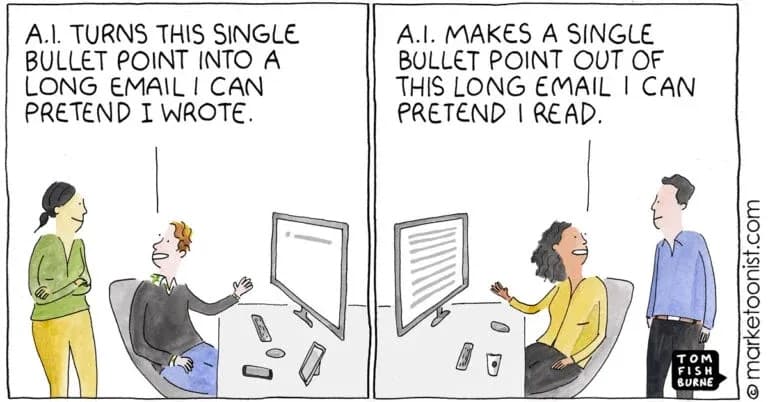
We have all seen this classic cartoon (Tom Fishburne / Marketoonist — see it in the original post).
I like this because it's a little too real: we've handed our communicating over to machines, and now we're buried under everything they produce.
And nobody drowns in that flood faster than someone who's easily pulled out of the moment — which is exactly what I am. I'm absent-minded; almost anything can distract me. And yet the thing I value most is deep focus: those rare, quiet hours when I can actually think. I also have a full life I love — music, tennis, travel, teaching at the university, my work, the people around me. None of it is the problem. The problem is that the noise makes it almost impossible to be present for any of it. So when I talk about being overwhelmed, I'm not describing a user persona. I'm describing myself :)
So I did what I always like to do — measured it. In a typical week, my inbox takes in about 5.4 million characters — a 500-page book, every single day. And when I looked at what it actually was, only about 3% came from a real person. The other 97% is broadcast: promotions, newsletters, automated messages — machines writing to me. AI is going to push that ratio much further, because it's never been easier to produce more.
Here's the part I keep coming back to: this isn't really a productivity problem. It's a cognitive one. It's happening to our minds.
The most valuable thing we do — deep, focused thinking, what psychologists call flow — depends on uninterrupted attention, and we keep chipping away at it. Twenty years ago we could hold focus on a single screen for about 2.5 minutes; today it's 47 seconds, and half of our focus bursts last 40 seconds or less (Gloria Mark, UC Irvine). As Johann Hari writes in Stolen Focus, the real cost isn't just distraction — it's a slow erosion of our ability to think deeply at all. That's worth taking seriously, and honestly it's a big part of why I'm building what I'm building.
But here's the good news — the reframe that changed how I see this: we don't actually have a thousand priorities. We have five to seven. A small set of people, projects and threads that make up our real life. For me it's my family, my music, my students, my work, tennis, the next trip — a short list. Everything else is background.
We call those few themes that matter your orbits. The problem was never a lack of information; it's that nothing separates the handful that matter from the thousands competing for the same attention.
That's exactly what we're building Orbit to do. It reads across your email, messages and calendar and organizes everything into your orbits — the few themes that actually make up your life — so you can finally see what's real, what's moving, and what's quietly draining your focus. Not another inbox. Not another feed. A curator whose only job is to hand you back the signal.
Sure, Orbit can act as an assistant too — draft the reply, answer a question, run the errand. But honestly, that's the easy part; every AI does that now. The hard part — the part almost nobody is building — is the layer underneath: an accurate, living model of your life. Get that right, and everything else becomes possible.
And I won't pretend it's easy — this is the part I find genuinely fun. Finding that 3% means understanding everything, not just filtering it, because the message that matters is buried in the flood. Keeping it accurate means processing continuously — hourly, and eventually in real time, because your orbit should know about the email that landed two minutes ago. And it's not only text — it's images, PDFs, voice notes, attachments, each carrying its own piece of the signal. Done naively, at the quality of today's best reasoning models, that runs somewhere between $500 and $1,000 per month for a single user — so you can imagine the engineering complexity. Making that curation performant is a big part of what we do at Orbit.
Because in the age of AI, you don't need another tool to help you produce more. You're already buried. You need one that protects the thing you can't make more of.
AI shouldn't be leaving us busier, shallower and more anxious. Done right, it should give us back our time, our attention and our ability to think — it should give us back our lives.
That's the whole point — and I'm truly excited we get to build it. 🚀
P.S. — Go ahead, paste this into your favorite AI for the one bullet point you can pretend you read. Kidding. (Mostly.)
—--------
Sign up to try Orbit at orbit.me